
Programmes
This page explains what programmes are, what types of programmes there are, which parties are required to submit programmes and what the respective programmes should look like.
Every day before 14:00 (LET), all Shippers must submit a programme for the following gas day, indicating the expected hourly gas flows. These programmes are used, among other things, to calculate the size of the buffer zones. The programmes must be submitted per portfolio.
We check whether the programmes are correct (see below) and confirms the result to the Shippers. The deadline for this process is day-ahead at 22:00 (LET).
VPPV: transfer point of balancing responsibility in the GTS network
The Energy Act stipulates that the transfer of balancing responsibility takes place at a virtual point. The VPPV has been set up for this purpose. All gas enters the system via this virtual point.
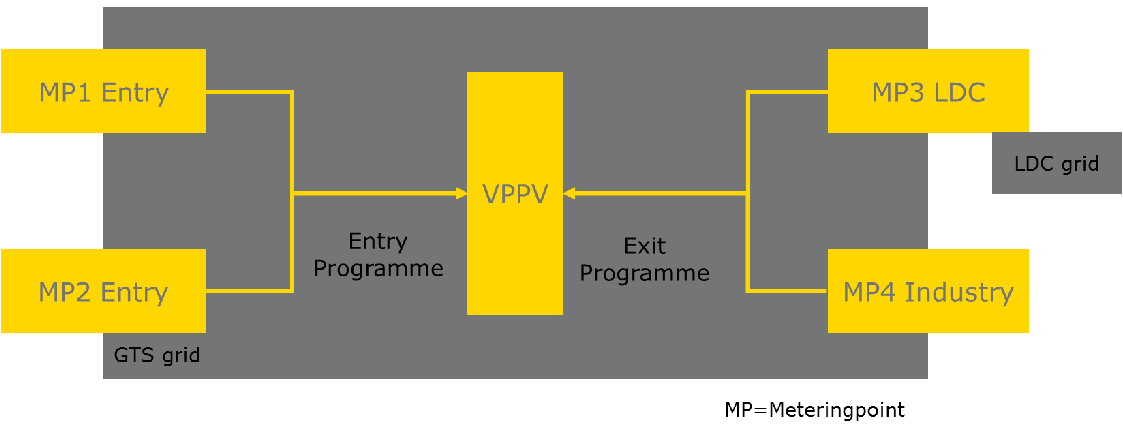
The VPPV is a combination of the trading transactions that take place on the TTF plus the transfer from a Shipper's own entry programme to its own exit programme.
Entry programme
In an entry programme, the Shipper specifies the total volume of the physical entry for the specific portfolio for each hour (in Figure 1, this is the sum of MP1 and MP2). In addition, the Shipper specifies the totalised volume of the transfers of balancing responsibility to the VPPV for each hour.
Exit programme
In an exit programme, the Shipper specifies the total volume of the physical exit for the specific portfolio for each hour (in Figure 1, this is the sum of MP3 and MP4). The physical exit must be divided into two exit flows: one for domestic consumers and one for other customers. The Shipper also specifies the totalised gas volume for which the balancing responsibility is transferred to the VPPV for each hour (if this has not already been done in an entry programme).
A Shipper with domestic consumers in its portfolio must apply the damping formula in the programme. Shippers without domestic consumers in their portfolio may only apply the damping formula in their exit programme if this has been indicated in advance to GTS (and confirmed by GTS).
Shippers can add their trading transactions to the entry or exit programmes; it is not necessary to submit separate programmes for this. When a Shipper applies damping, it is recommended to add the trading transactions to the entry programme.
Trading programme
Pure traders (i.e. parties that only trade on TTF) submit a trading programme without physical entry or exit. The programme specifies the total traded volume for each hour.
When mutually agreeing on a trading transaction, parties must agree on when to include the trading transactions in the programme. A guideline for this is that transactions concluded before 21:00 (LET) are still included in the programme. This gives both parties sufficient time to include the transaction before the deadline of 22:00 (LET).
Of course, trading on the TTF is still possible after this deadline; the same applies to renominations at entry and exit points.
Damping in exit programmes
The damping formula is only applied to exit programmes. This formula ensures that for each hour, the combination of entry and exit is in line with the physical situation of the gas transport network. Every day before 09:00 (LET), GTS announces the parameters of the damping formula for the following day. Our website contains a detailed explanation of the use of damping and the damping formula.
What type of programme should you submit and in which programme should trade transactions be included?
The type of programme you need to submit depends on the types of capacity you have contracted. The following are the possible situations:
| You are operating exclusively on TTF | You only send a Trade programme, which includes the sum of the trades. |
| You have booked both entry and exit capacity | You only send a Trade programme, which includes the sum of the trades. You submit an Entry and an Exit programme. If you are also active on TTF, you preferably include the sum of the trades in the Entry programme. |
| You have booked entry capacity, but no exit capacity | You only submit an Entry programme. If you are also active on TTF, include the sum of the trades in this programme. |
| You have booked exit capacity, but no entry capacity | In this case, you only submit an exit programme. If you are also active on TTF, include the sum of the trades in this programme. |
Checks on programmes
To ensure that the national gas network is in balance for the next gas day, checks are carried out to ensure that the transfers on the VPPV correspond in terms of counterparty, volume, runtime and flow direction. For entry, trading and exit programmes without damping, checks are carried out to ensure that the entry and exit quantities are the same for each hour. For exit programmes with damping, checks are carried out to ensure that the formula has been applied correctly.
If a programme is incorrect, this is reported back to the submitter and certain correction rules are applied. Parties can submit amended programmes until the closing time of 22:00 (LET).
Exit Programme
| Exit programme (ppt) | File extension ppt | File size 575 kB | Date last updated 20 Apr 2023 |
| Exit programme (xlsx) | File extension xlsx | File size 16 kB | Date last updated 20 Apr 2023 |
Entry Programme
| Entry programme (ppt) | File extension ppt | File size 672 kB | Date last updated 20 Apr 2023 |
| Entry programme (xlsx) | File extension xlsx | File size 21 kB | Date last updated 20 Apr 2023 |
Trade programme
| Trade programme (ppt) | File extension ppt | File size 533 kB | Date last updated 20 Apr 2023 |
| Trade programme Xlsx) | File extension xlsx | File size 12 kB | Date last updated 20 Apr 2023 |