
Disruption in the information supply systems on 24 September 2024 - update
On the 24th of September a Within Day Balancing Action (WDBA TR004817) took place, caused by a disruption in the information supply systems related to balancing. This news item explains what happened and describes how GTS has acted and will act to deal with this issue.
Due to the disruption, a number of shippers experienced a sudden jump in their Portfolio Imbalance Signal (POS) in the long direction. As a result thereof, the System Balance Signal (SBS) made a jump of approximately 34 GWh in the long direction.
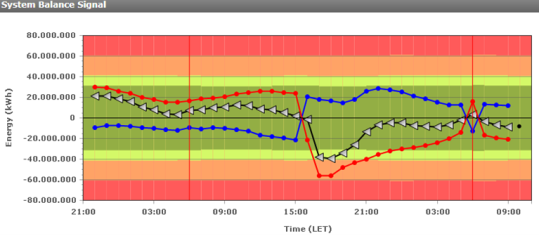
The situation may have affected shippers in two ways:
- As a causer of the balancing action, shipper were faced with an unfavourable price resulting from the balancing action, and/or
- the jump in the POS led shippers to correct their POS (e.g. by selling gas or injecting gas into a storage).
1. Unfavourable price of the WDBA
As previously communicated via e-mail and the website of GTS, the WDBA was caused by a disruption in the information supply systems. In such situations, article 4.1.4.6 of the Transmission Code Gas - TSO comes into effect. Consequently, the financial settlement of this WDBA has been done in line with article 4.1.4.6 sub 3:
During a situation in which the information supply system is disrupted, a possible WDM transaction with the causer is settled against the neutral gas price pursuant to 4.1.6.4.
As a result, we have sent the affected shippers (the causers of the WDBA) two invoices (on 1 October): one regarding the cost of the WDBA (at approximately minus € 1,175 per MWh) and a second one, being a correction invoice in accordance with article 4.1.4.6 sub 3, in which we correct the first invoice by deducting in full the cost of the first invoice and charging these shippers the neutral gas price (€ 35.897 MWh).
2. Adjusting the POS
During the situation, GTS advised, as usual, to manage their POS adequately. In hindsight we know that the POS of several shippers was affected by the disrupted information supply systems and that the near-realtime (NRT) allocation was not in line with the amount of gas that actually flowed. This will be corrected in the offline allocation data. Differences between NRT and offline allocation data will be settled, as usual, with the neutral gas price of the relevant day. You can expect the settlement invoice regarding the September 24 data as of 4 November 2024.
Pricing of the Next Hour product
GTS is, in general terms, analysing the situation regarding the notable pricing of the WDBA (in this case minus € 1.175 MWh) and is discussing this topic with ICE. Developments regarding the volume, price setting and liquidity of, especially, the Next Hour product are important for the whole market. GTS shall take sufficient time to investigate the cause of the remarkable pricing and work on solutions that will be helpful towards the entire market. At the shipper meeting on 7 November, we hope to give you an update.
Hopefully we have informed you sufficiently. If you have any further questions, please contact GTS Customer Desk at customerdesk@gastransport.nl.
FAQ
Q: Why does Gasunie use ICE for balancing in the orange zone and not EEX spot? Is EEX spot not more liquid?
A: We are aware of the perceived issue with the price forming of the Next Hour product that we use for balancing in the orange zone. We believe that switching to another exchange will not solve this issue, but rather that the poor liquidity has its roots in the nature of the product and the lack of parties who can physically deliver the product, allowing for fairer competition based on cost.
We are investigating potential solutions and will present our findings in a market session.
Q: Will the offline allocation settlement have any effect on our POS?
A: No, an offline allocation settlement is a settlement from a financial perspective only. The settlement is designed to give you a fair price for the amount of gas you had to sell in this case.
Q: Why should we take action on our POS, even if this is based on disrupted information?
A: It is a fact that a POS is not always correct, e.g. due to unreliable measurements, however, a POS is never adjusted. The differences between NRT and offline allocation data are settled at the neutral gas price of the day in question.
Q: Is there a risk that shippers will face exceeding penalties because of this disrupted POS?A: No, as mentioned above the offline allocation will be based on the gas that actually flowed. Exceeding invoices are based on the offline allocations, not on the NRT data.